
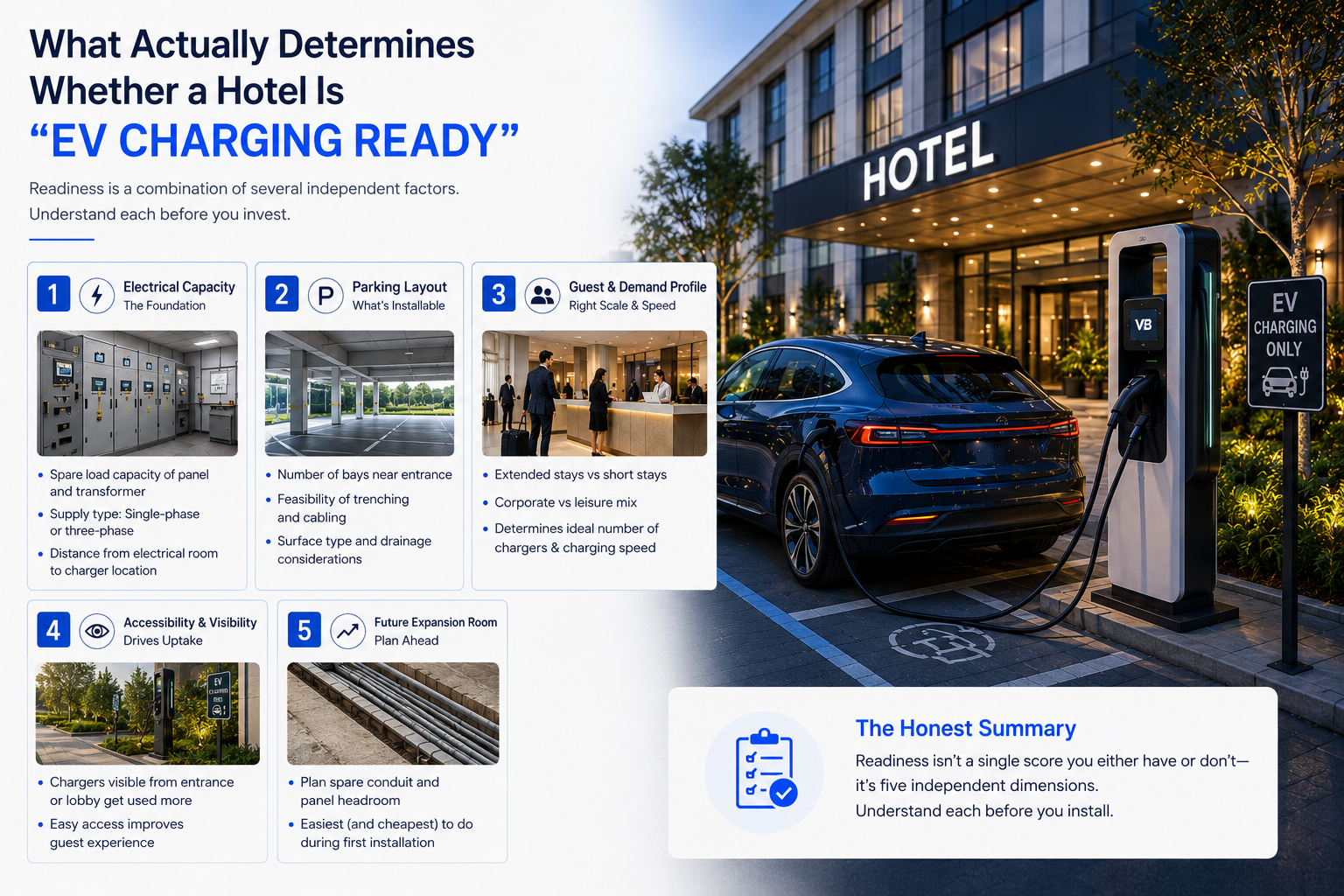
“Is my property ready for EV charging?” sounds like a yes-or-no question. It isn't — readiness is a combination of several independent factors, and understanding them individually is more useful than any single verdict.
Electrical capacity is the foundation, and the one most often skipped.
Before anything else, a property needs to know its spare load capacity — how much additional electrical draw the existing panel and transformer can safely support — along with supply type (single-phase or three-phase) and the physical distance from the electrical room to where chargers would sit. Skipping this step is the single most common reason EV charging projects run over budget: discovering a capacity shortfall after equipment has already been ordered is far more expensive to fix than catching it during planning.
Parking layout shapes what's actually installable.
How many bays sit close to the entrance, whether the surface allows straightforward trenching for cabling, and whether existing drainage would interfere with civil work all affect both cost and the realistic number of chargers a site can support.
Guest and demand profile determines the right scale.
A property with a high proportion of extended corporate or relocation stays has a fundamentally different charging usage pattern than one dominated by one-night leisure guests. This affects not just how many chargers make sense, but what charging speed is actually useful — a guest staying a week has very different needs from one staying twelve hours.
Accessibility and visibility affect uptake, not just installation.
A charger tucked in a far corner of a parking structure gets used less than one visible from the entrance or lobby — a detail that's easy to overlook when planning focuses purely on the technical side.
Future expansion room is worth planning for even if you start small.
The cheapest time to lay spare conduit or plan panel headroom for a second phase of chargers is during the first installation — not two years later when demand has grown and the property is operating at full capacity.
The honest summary.
Readiness isn't a single score you either have or don't — it's six or so independent dimensions, each worth understanding on its own terms before any equipment gets chosen.