
Search for “EV charging ROI calculator” and you'll find tools promising dramatic revenue increases — some implying that installing a charger meaningfully boosts a property's overall occupancy. It's worth being skeptical of these numbers, and worth understanding what's actually calculable today versus what isn't.
What's genuinely calculable: charging fee revenue.
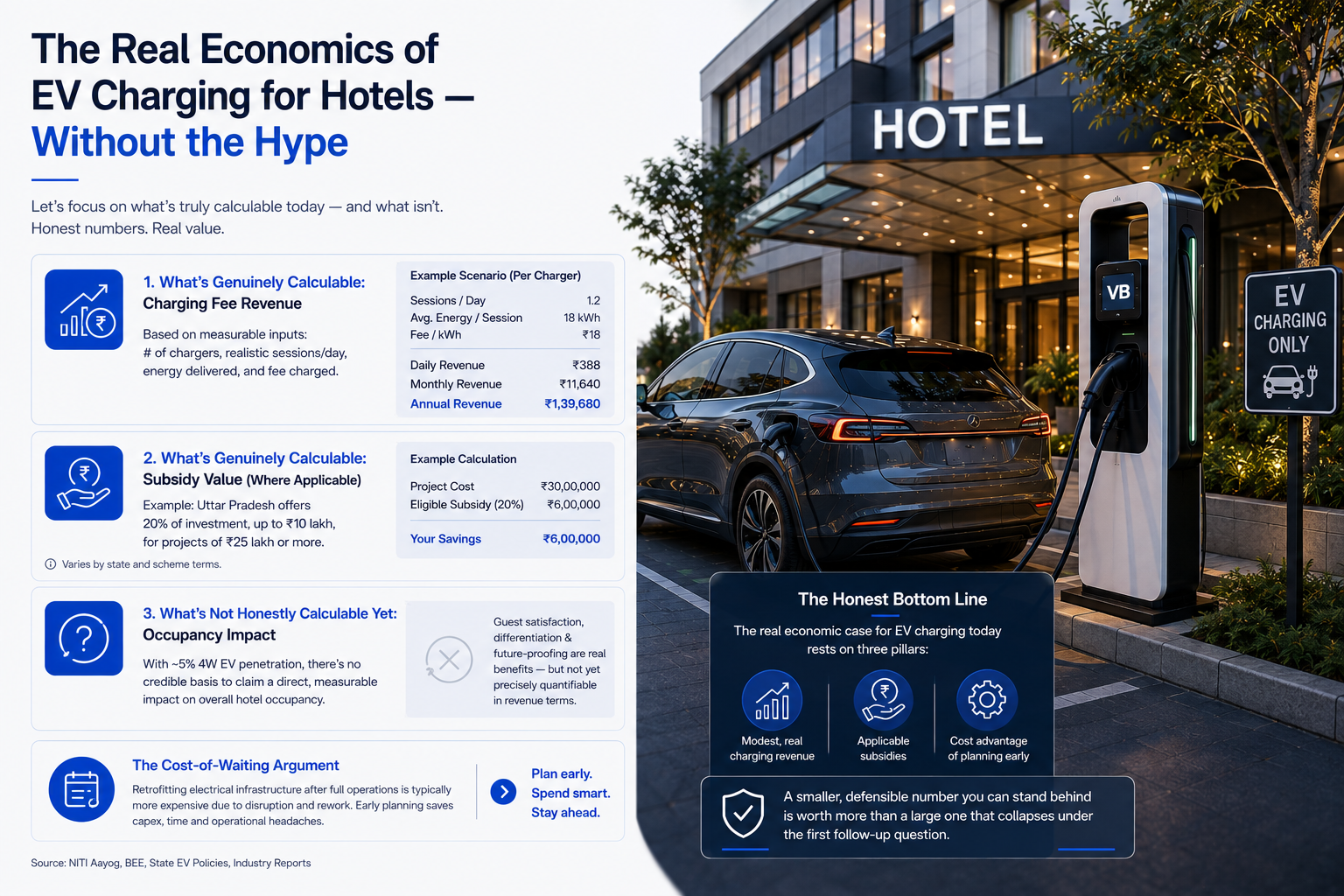
If a property charges guests per kWh delivered, this is straightforward and defensible: number of chargers, realistic sessions per day given current EV adoption, average energy delivered per session, and the fee charged. At today's adoption levels, this produces a modest but real number — not a dramatic one, and that's an honest reflection of where the market currently stands, not a flaw in the calculation.
What's genuinely calculable: subsidy value, where applicable.
Uttar Pradesh, for example, offers a capital subsidy — 20% of investment, up to ₹10 lakh — but only for projects of ₹25 lakh or more, typically a larger, multi-charger installation rather than a first one or two chargers. Where a project qualifies, this is real, quantifiable value. Where it doesn't, it's honest to say so rather than stretch the claim.
What's not honestly calculable yet: occupancy impact.
With four-wheeler EV penetration still around 5% nationally, there is no credible basis for claiming that installing a charger directly and measurably increases overall hotel occupancy by any specific number. Guest satisfaction, competitive differentiation, and future-proofing are real, legitimate benefits — but converting them into a precise revenue figure today is guesswork dressed as data.
The cost-of-waiting argument.
Often more persuasive than any revenue projection: retrofitting electrical infrastructure after a property is fully operational is commonly more expensive than integrating the same work during planned upgrades or new construction, due to the disruption and rework involved. This is a genuine financial argument for early planning — independent of how fast EV adoption grows.
The honest bottom line.
The real economic case for EV charging today rests on modest, real charging revenue, applicable subsidies, and the cost advantage of planning early — not on inflated occupancy projections. A smaller, defensible number you can stand behind is worth more than a large one that collapses under the first follow-up question.