
India's EV story is often told in two contradictory ways — either as an unstoppable wave already reshaping the roads, or as a niche curiosity years away from mattering. Neither is quite right, and the actual data tells a more useful story for anyone deciding whether to invest in charging infrastructure today.
The headline number, and what it actually means.
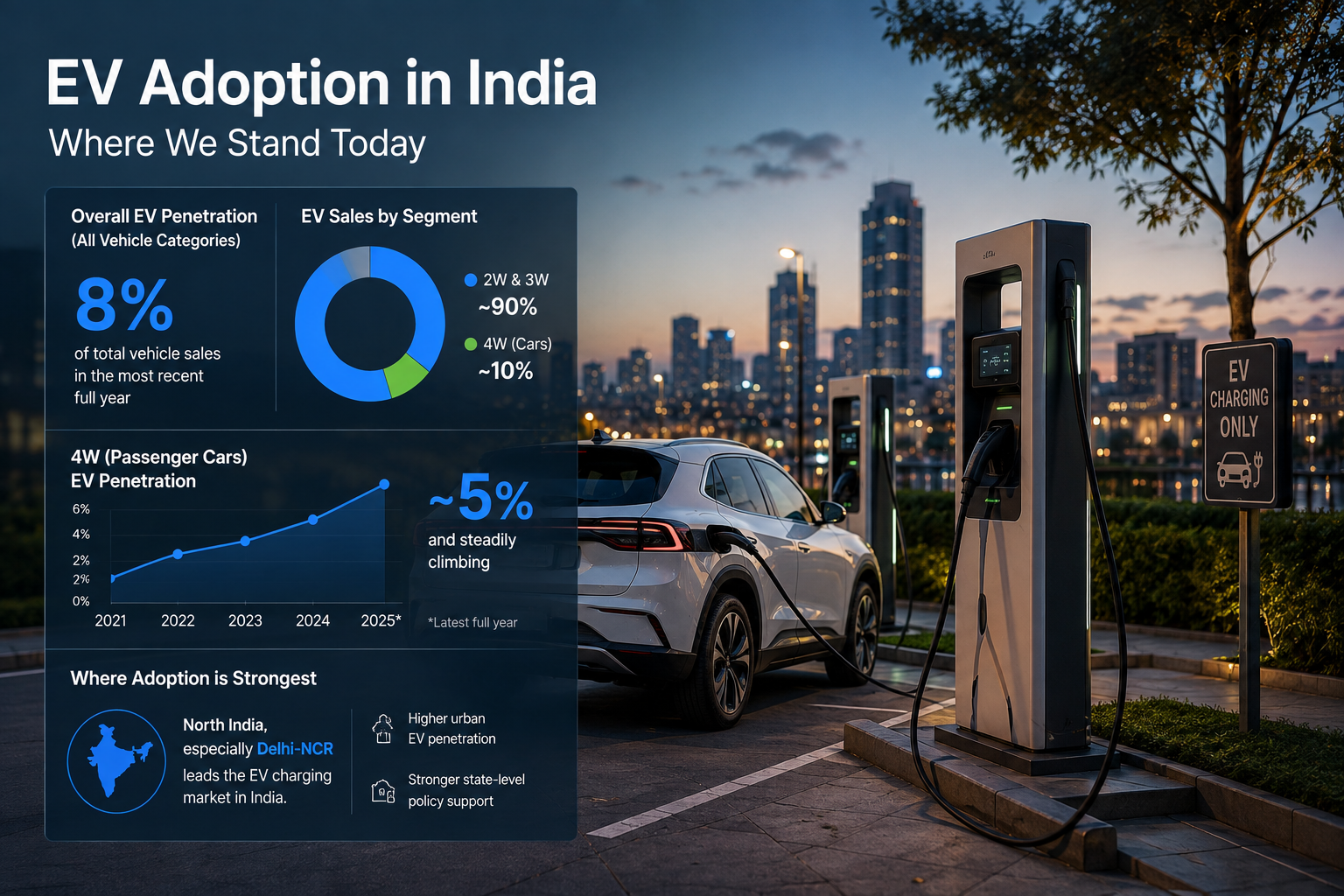
India's overall EV penetration — across all vehicle categories — crossed roughly 8% of total vehicle sales in the most recent full year. That sounds significant, and it is, but the number hides an important detail: it's driven overwhelmingly by two- and three-wheelers, which make up around 90% of total EV volume. Passenger cars — the vehicles that actually check into a hotel — are a much smaller slice. Four-wheeler passenger EV penetration sits at roughly 5%, having climbed steadily but starting from a low base.
Why this matters for commercial property owners.
If you're evaluating EV charging for a hotel, office, or retail property, the honest starting point is: today, one in twenty new cars sold is electric, not one in five. That's real, growing demand — not yet mainstream demand. Planning infrastructure around “everyone will have an EV next year” leads to over-building; planning around “no one has one yet” leads to being caught flat-footed once adoption crosses a tipping point, which most industry forecasts still expect within the next several years.
Where you're located actually matters.
Adoption isn't uniform across India. North India, and Delhi-NCR specifically, holds the largest share of the country's EV charging market — a combination of higher urban EV penetration and a more active state-level policy environment than most other regions. A property in NCR is genuinely better positioned for early charging demand than the same property would be in a slower-adopting state.
The practical takeaway.
EV charging infrastructure decisions today should be sized for gradual, real growth — not a hypothetical surge, and not dismissed as premature either. The properties best positioned five years from now are the ones that planned modestly and correctly today, not the ones that either overbuilt on hype or ignored the trend entirely.
Sources: NITI Aayog, Bureau of Energy Efficiency (BEE), Global EV Outlook.
← All insights