
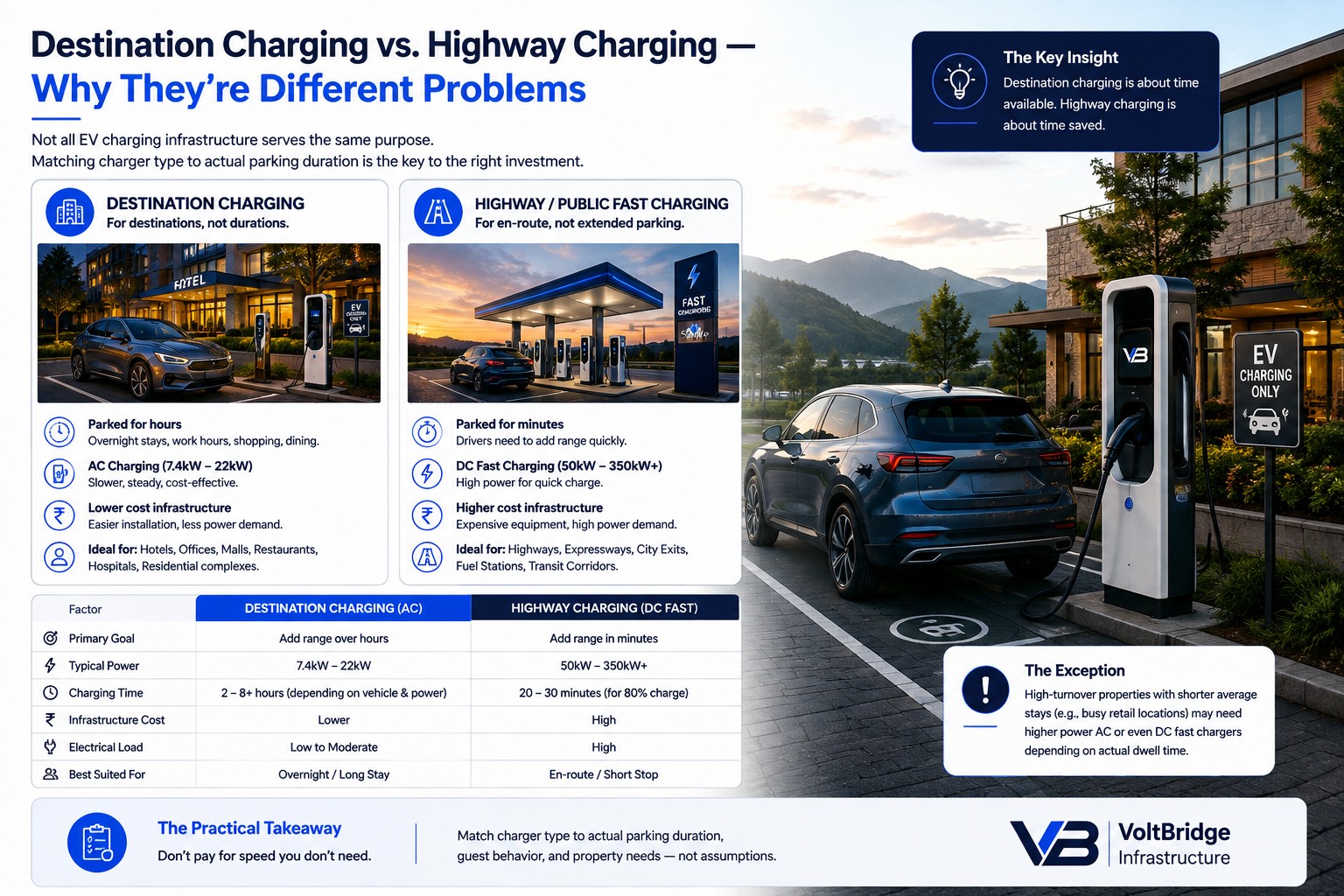
Not all EV charging infrastructure serves the same purpose, and conflating the two leads to poorly-matched equipment decisions.
Highway and public fast charging exists to minimize time.
A driver mid-journey needs to add significant range quickly — this is the use case for DC fast charging, delivering 50kW and above, capable of adding substantial charge in 20-30 minutes. This equipment is expensive, power-hungry, and requires serious electrical infrastructure to support.
Destination charging exists for a completely different scenario.
A vehicle that's already going to be parked for hours anyway. A hotel guest staying overnight, an office employee at work for the day, a mall visitor shopping for two hours — none of these situations require fast charging, because the vehicle has time. This is the domain of AC charging, typically 7.4kW to 22kW, which costs a fraction of DC fast charging infrastructure and asks far less of a property's electrical system.
Why this distinction matters practically.
A hotel considering EV charging doesn't need — and shouldn't pay for — DC fast charging infrastructure sized for a highway rest stop. Guests aren't in a hurry to leave; they're parked overnight. The right equipment for destination charging is meaningfully cheaper, simpler to install, and easier on existing electrical capacity than the fast-charging infrastructure many people assume is required.
The exception worth knowing.
Properties with high vehicle turnover and shorter typical stays — a busy retail location, for instance — sit somewhere between these two categories, and the right equipment choice depends on actual guest dwell time, not assumptions.
The practical takeaway.
Matching charger type to actual parking duration, rather than defaulting to the fastest available equipment, is one of the simplest ways to avoid unnecessary cost in an EV charging project.